|
Hand in hands
Join
hands with nationals involved in Bible translation - help
top up their support from their local churches..
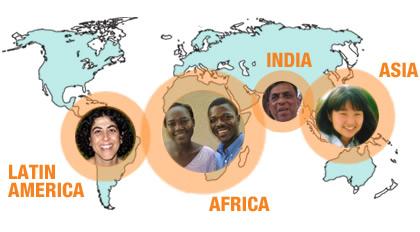
Churches in Africa, Asia and Latin America are ready to send
their people to be involved in Bible translation for people
groups within their country or in other countries. It is
exciting to see the worldwide church responding to God's
call to mission. Vision 2025 depends on the Church in Africa,
Asia and Latin America mobilising thousands of workers
to go to where God is calling them.
Jing from the Philippines shares, "I saw a vision of
a large crowd of people. In that vision some were tall, others
were short, some were white and others were black. They were
wearing their tribal costumes, were raising their hands in
worship to God. I was in the midst of them." This vision
pursued her and ignited her calling to go to mission. In
the next few months, she and her husband will be moving to
another part of Asia where there are few believers in order
to translate God's word.
Their churches, their friends and families are giving as
much as they can but it is not sufficient for the workers
needs. They are giving out of their poverty. Sometimes this
is only 25% of their needs, sometimes it is up to 60%. This
means that sometimes the gap in support is small - £60/$110/€90
per month, sometimes much larger - £500/$900/€750
per month. This depends on the context they are working in
and their family circumstances.
Please give what you
can. £10/$20/€15 can make a difference
when added together with gifts from other sponsors.
Find out more about some of the workers involved in making
Vision 2025 a reality, by click an area of the map above.
Vision 2025 is a Wycliffe initiative.
This website is managed by Wycliffe UK on behalf of the worldwide
Bible translation movement. Wycliffe UK is a UK registered
Charity no. 251233
|